

Executive Officer to School Administration
Employment Communications, Staffing Decisions, Administrative Correspondence, and Documentary Records
This page presents documents, communications, employment records, and supporting evidence relating to the Executive Officer function at International Christian School Nonthaburi (ICSN). The record includes recruitment communications, employment discussions, staffing decisions, administrative correspondence, and related documentation for independent review.

Nathaniel (Nate) Gurnett
Executive Officer to School Administration
This section presents communications, employment correspondence, staffing records, and administrative documents associated with Nathaniel Gurnett in his role as Executive Officer to School Administration at International Christian School Nonthaburi (ICSN). The materials provide context regarding recruitment activities, employment communications, staffing decisions, and administrative actions documented during the period under review.
The documentary record includes recruitment communications, employment discussions, medical leave communications, staffing coordination, and correspondence relating to employment decisions. Several documents reflect interactions between the Executive Officer function, school leadership, and employees during significant administrative and employment-related events.
Readers are encouraged to review the original documents and supporting evidence and assess the communications, decisions, and explanations provided within the record. The purpose of this archive is to preserve relevant documentary materials and provide context for independent review and evaluation.
Employment Communications
This section examines employment decisions, administrative communications, and termination documents associated with the Executive Officer's involvement in the events leading to the employee's removal from classroom duties and subsequent termination.
The documents include correspondence regarding medical leave, reassignment of teaching responsibilities, requests for consultation, termination communications, proposed settlement terms, continued insurance arrangements, and allegations cited as justification for dismissal. Together, these records provide a chronological account of the decision-making process and the actions taken during a period when the employee was hospitalized following a serious medical emergency.
The majority of the documents presented on this page were preserved and provided by a former employee directly involved in the events described. However, the issues reflected in the record extend beyond a single employment dispute. Multiple former employees and parents have raised concerns regarding administrative practices, employment procedures, safeguarding matters, insurance administration, and dispute resolution processes. Readers are encouraged to review the original documents and supporting evidence to evaluate the procedures followed, the explanations provided, and the consistency between the documented record and subsequent actions affecting employment, insurance coverage, and student enrollment.

Exclusion from the Decision-Making Process
Refusal to Meet, Consultation Denied, and Decisions Made Without Employee Participation
The documents show that major employment decisions were made while the employee remained hospitalized following a serious spinal cord injury. Records indicate that leadership concluded consultation would not meaningfully contribute to the decision-making process and proceeded with permanent staffing decisions before any direct meeting occurred. The record further reflects repeated requests for discussion, including requests for meetings and conference calls, which were ultimately rejected or deemed unnecessary. Readers may examine whether meaningful participation, consultation, or procedural fairness was provided before employment decisions were finalized.

Community Safety Allegations
Hospitalization, Legal Threats, and the Subsequent Narrative
The termination documents rely heavily upon allegations that the employee presented a threat to the school community. At the time of the alleged conduct, however, the employee was hospitalized, suffering from a severe spinal cord injury, under medical care, and physically incapacitated. The communications referenced in the termination documents arose during discussions concerning medical treatment, insurance coverage, legal rights, and the consequences of decisions being made while the employee remained hospitalized.
The record contains no evidence that school-wide safeguarding procedures were activated, no witness interviews, no disciplinary hearing, no independent investigation, and no documented opportunity for the employee to respond before termination. No police report, safeguarding assessment, or external review appears within the documentary record presented on this page.
The timing of the allegations is also notable. Communications from school leadership immediately following the incident remained supportive and focused on medical treatment, employment discussions, and administrative assistance. The narrative that the employee represented a community safety threat emerged several days later and subsequently became a central justification for termination. Readers are encouraged to review the chronology of communications, compare the contemporaneous records with the later explanations provided, and assess the consistency of the documented record.

Health Insurance and Benefit Leverage
Medical Coverage, Release Conditions, and Loss of Future Access to Care
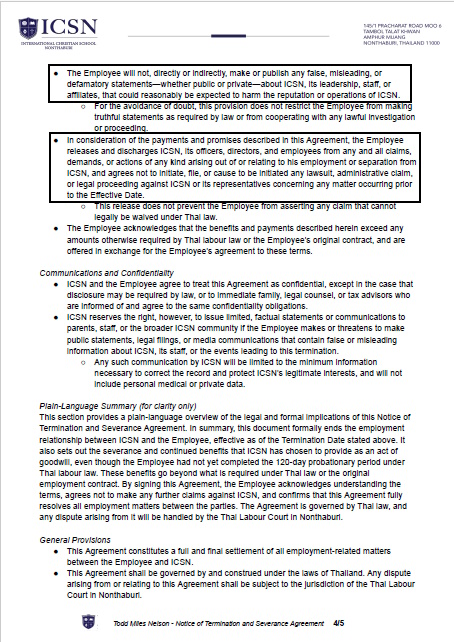
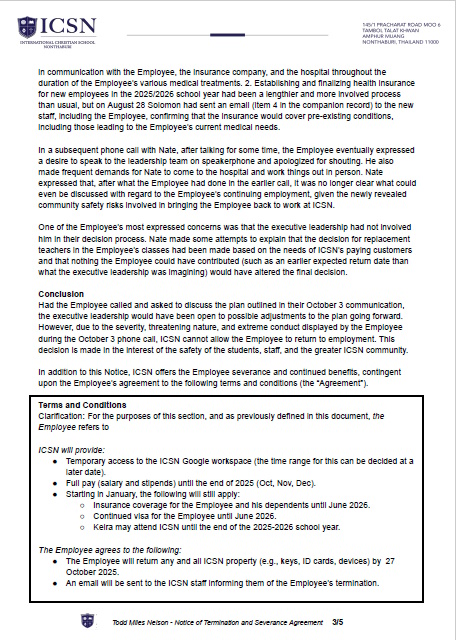
The termination and settlement documents conditioned continued health insurance coverage, visa sponsorship, and continued enrollment for the employee's child upon acceptance of a settlement agreement. The proposed agreement required the employee to release legal claims, execute a hold harmless agreement, accept confidentiality and non-disclosure provisions, and waive the right to pursue future action against the school and its representatives. Failure to sign resulted in withdrawal of these benefits.
The significance of these conditions cannot be separated from the employee's medical circumstances. At the time the proposal was presented, the employee was recovering from a catastrophic spinal cord injury, remained under active medical care, and required continuing treatment, rehabilitation, specialist consultations, diagnostic testing, and ongoing neurological monitoring.
The loss of insurance coverage was not simply the loss of an employment benefit. It eliminated access to the only medical coverage available for treatment of an existing spinal cord injury that had already resulted in permanent neurological impairment. Once employment ended and coverage ceased, the employee faced the prospect of funding future treatment personally while simultaneously confronting the practical reality that serious pre-existing spinal injuries are often difficult or impossible to insure under new policies.
The documents therefore present a situation in which continued access to medical treatment, ongoing insurance coverage, immigration status, and a child's continued education were linked to the execution of legal releases and confidentiality provisions. Readers are encouraged to review the settlement documents, insurance communications, and termination correspondence and draw their own conclusions regarding the relationship between continued medical coverage and the relinquishment of legal rights during recovery from a life-altering injury.

Termination and Release Agreement
Waiver of Claims, Confidentiality Requirements, and Employment Separation
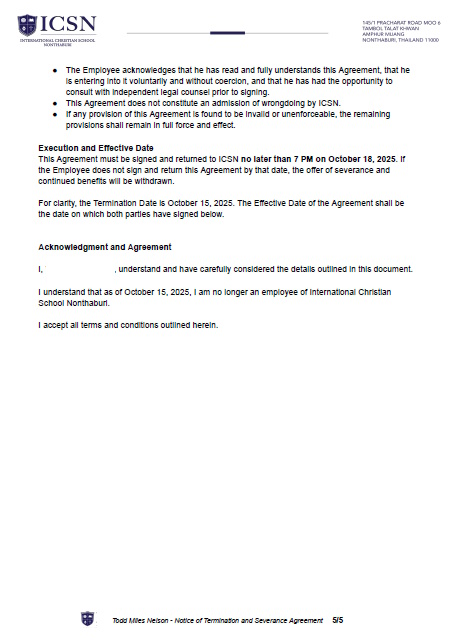
The termination package required the employee to decide within approximately three days whether to accept a settlement agreement that included a release of legal claims, hold harmless provisions, confidentiality obligations, non-disclosure requirements, and restrictions on future action against the school and its representatives. Failure to sign would result in withdrawal of continued benefits, including health insurance, visa sponsorship, and continued enrollment for the employee's child.
The timing of the proposal is significant. The agreement was presented while the employee was recovering from a catastrophic spinal cord injury, remained under active medical care, and was experiencing significant physical limitations. The record reflects that the employee had recently undergone major surgery, required assistance with many daily activities, and remained focused on medical recovery.
The documents further show that school representatives maintained communication during this period, including telephone calls and discussions regarding the proposed agreement. At the same time, the employee was being asked to waive legal rights, release potential claims, accept confidentiality obligations, and make decisions with significant long-term consequences for medical treatment, immigration status, and family stability.
The record therefore presents a situation in which a seriously injured employee was required to make substantial legal and financial decisions within a very short period of time while recovering from a life-altering injury. Readers are encouraged to review the settlement documents, termination correspondence, and supporting communications and draw their own conclusions regarding the circumstances under which the proposed agreement was presented and the conditions attached to continued benefits.
Image Gallery
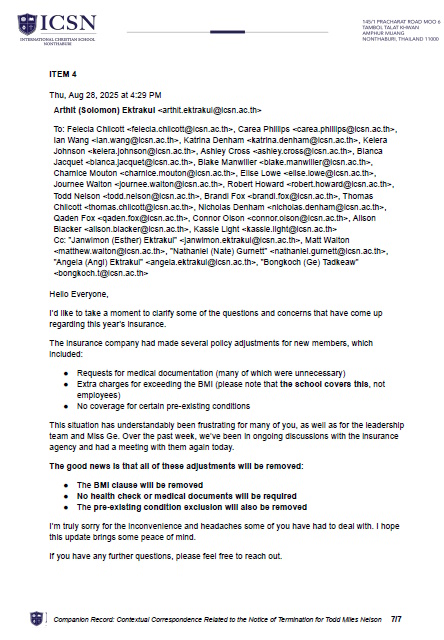
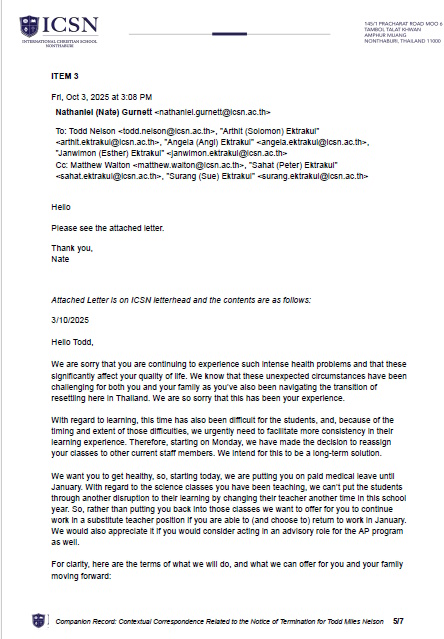
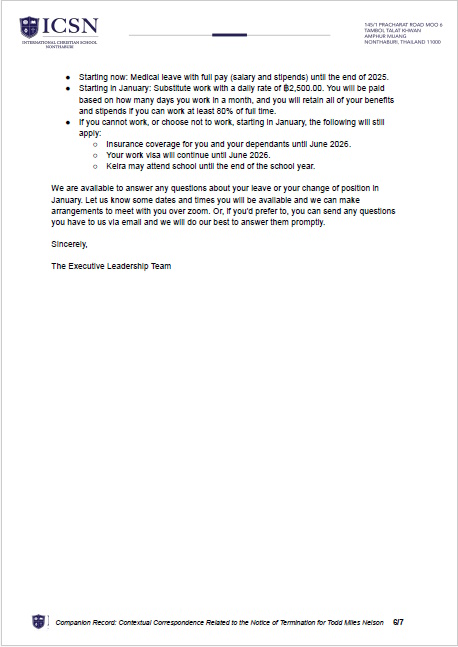
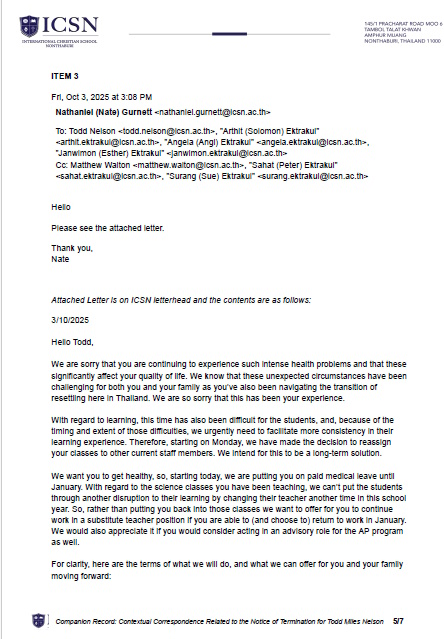
This section contains correspondence and employment records relating to proposed reassignment, medical leave, community safety allegations, termination decisions, and separation agreements. The documents raise questions regarding consultation, procedural fairness, continued access to health insurance, and the consistency of explanations provided during a period of serious medical recovery. Most documents were preserved by a former employee directly involved in the events described and are presented in chronological order for review.
Independent AI Analysis of Executive Administration Records
Consultation, Employment Decisions, and Preferential Treatment
The documentary record indicates that major employment decisions were made before meaningful consultation occurred with the employee. While hospitalized with a catastrophic spinal cord injury, the employee repeatedly requested direct discussions regarding his medical condition, treatment options, recovery timeline, and future employment. Those requests were not accommodated. Instead, employment decisions were communicated by email while the employee remained hospitalized and medically incapacitated.
The October 3 correspondence proposed removing the employee from his AP teaching position, replacing him in his classes, assigning substantially different duties, and reducing compensation through conversion to a daily-rate structure. These decisions were presented before any documented recovery timeline had been established and before the employee had been provided an opportunity to participate meaningfully in discussions regarding his future employment.
Subsequent termination correspondence attempts to justify the lack of consultation by asserting that discussions would not have altered the outcome. This position raises significant concerns. Decisions appear to have been made first, with explanations provided afterward. The record contains little evidence that Executive Leadership sought medical clarification, evaluated recovery projections, or conducted a meaningful review of alternatives before implementing employment changes.
The proposed compensation structure would have reduced earnings by more than one-third while simultaneously removing the employee from the position for which he had been recruited internationally. The practical effect would have been a dramatic reduction in family income at a time when medical expenses were escalating and the employee was physically unable to perform alternative duties.
The documents also raise questions regarding consistency in the administration of medical leave. Executive Leadership justified rapid employment action on the basis of the employee's medical absence, despite the employee having been absent only a matter of weeks following a documented spinal cord injury. At the same time, the spouse of an excutive leadership member received substantially longer periods of leave without comparable reductions in duties, compensation, or employment status. Readers may wish to consider whether the treatment reflected consistent application of policy or whether similarly situated employees were treated differently.
Taken together, the record raises significant questions regarding procedural fairness, consultation, medical accommodation, compliance with Thai labour protections, and whether employment decisions were predetermined before relevant facts had been established.
Community Safety Allegations, Consultation, and Contradictory Explanations
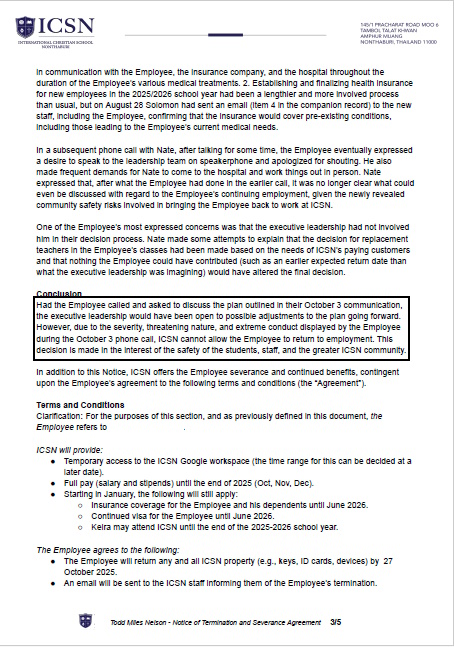
The documentary record shows that the October 3 telephone call ultimately became the principal basis for termination. The termination correspondence characterizes the conversation as creating concerns regarding the safety of the ICSN community and relies heavily upon that conclusion to justify the employment actions that followed.
However, the actions of school leadership immediately following the call appear inconsistent with the later narrative. The Executive Officer participated in additional telephone discussions with the employee. School principals continued communicating with the family regarding medical recovery and employment matters. Executive Administration arranged for food to be delivered to the family's residence. The documentary record does not reflect the type of immediate response ordinarily associated with a genuine threat to students, staff, or the wider school community.
The chronology is equally notable. The call occurred on October 3 while the employee was hospitalized and physically incapacitated following a catastrophic spinal cord injury. No safeguarding investigation was initiated. No threat assessment was conducted. No witness interviews were completed. No disciplinary hearing occurred. No documented emergency safeguarding procedures appear to have been activated. Approximately five days later, the same conversation emerged as the foundation of a community safety narrative that ultimately became a primary justification for termination.
The termination correspondence itself contains a significant contradiction. In the same discussion that characterizes the employee as a community safety concern, leadership states that it would have welcomed further discussions regarding employment arrangements and future opportunities and suggests that the employee simply failed to contact the school. Yet the employee remained hospitalized, recovering from major spinal surgery, physically incapacitated, and heavily focused on medical treatment and rehabilitation. The record further shows that requests for direct discussions regarding employment matters had already been made and that major employment decisions had already been communicated before any meaningful consultation occurred.
These positions are difficult to reconcile. If leadership genuinely believed the employee posed a serious risk to the school community, it is unclear why future employment discussions would remain open for consideration. Conversely, if leadership remained willing to discuss future employment opportunities, questions naturally arise regarding the severity and immediacy of the alleged safety concerns. Readers are encouraged to compare the contemporaneous actions of school leadership, the language contained within the termination correspondence, and the chronology of events reflected throughout the documentary record when evaluating the consistency of the explanations provided.
Requests for Discussion, Decisions Made in Advance, and Procedural Fairness
The documentary record indicates that major employment decisions were made before meaningful consultation occurred with the employee. While hospitalized with a catastrophic spinal cord injury, the employee repeatedly sought direct discussions regarding his medical condition, treatment options, recovery timeline, and future employment. Rather than engaging in those discussions, Executive Leadership communicated major employment decisions by email while the employee remained hospitalized and medically incapacitated.
The October 3 correspondence proposed removing the employee from his AP teaching position, replacing him in his classes, assigning substantially different duties, and reducing compensation through conversion to a daily-rate structure. These decisions were communicated before any documented recovery timeline had been established and before the employee had been provided a meaningful opportunity to participate in discussions regarding his future employment.
The record further shows that requests for direct discussions were treated as inappropriate or unnecessary. Termination correspondence later criticized the employee for insisting upon face-to-face discussions and suggested that consultation would not have meaningfully contributed to the decision-making process. This position raises important questions regarding procedural fairness. In most professional environments, significant decisions involving medical leave, reassignment, compensation changes, and continued employment would ordinarily involve direct discussion with the affected employee before implementation. In this case, the record reflects the opposite sequence: decisions were made first and explanations were provided afterward.
The circumstances surrounding those decisions are also significant. At the time the employee requested meetings and discussions, he was hospitalized following a catastrophic spinal cord injury, facing uncertainty regarding recovery, treatment options, and future mobility. The request for direct communication was not unusual. It was a request to discuss employment decisions that directly affected income, insurance coverage, immigration status, medical treatment, and family stability. The documentary record shows that these requests were not accommodated despite the extraordinary circumstances.
The termination correspondence also presents a further contradiction. Leadership later stated that additional employment discussions would have been welcomed and suggested that the employee simply failed to contact the school. Yet the same record shows that requests for discussions had already been made, major employment decisions had already been communicated, and the employee remained hospitalized and recovering from major spinal surgery. Readers may therefore question whether meaningful consultation was ever genuinely available or whether the outcome had already been determined before those discussions could occur.
Taken together, the record raises significant questions regarding procedural fairness, employee participation, medical accommodation, and whether decisions affecting employment, compensation, and future benefits were made before the relevant facts had been established or discussed with the employee most directly affected by them.
Waiver of Rights, Confidentiality Requirements, and Loss of Essential Benefits
The separation agreement required the employee to make a decision within approximately three days while recovering from a catastrophic spinal cord injury and major spinal surgery. The proposed agreement required acceptance of broad legal releases, confidentiality obligations, non-disclosure provisions, and hold harmless clauses protecting the school and its representatives from future claims arising from the events described throughout this record.
The practical consequences of refusing the agreement were substantial. The documents show that continued health insurance coverage, visa sponsorship, and the continued enrollment of the employee's daughter were tied to acceptance of the proposed terms. Rejection of the agreement resulted in loss of those benefits.
The significance of these conditions cannot be separated from the employee's medical circumstances. At the time the agreement was presented, the employee remained hospitalized, faced permanent neurological impairment, required continuing medical treatment, and depended upon continued access to health insurance for ongoing care. The proposed agreement therefore linked access to essential medical coverage and family stability with the relinquishment of legal rights and acceptance of confidentiality obligations.
The record further shows that the agreement required the employee to accept the school's version of events while waiving the right to pursue future claims relating to employment, insurance administration, medical consequences, and other matters arising from the dispute. The employee was therefore faced with a choice between preserving legal rights or maintaining access to health insurance, visa sponsorship, and his daughter's continued enrollment at the school.
Readers are encouraged to review the agreement itself and consider the circumstances under which these conditions were presented, including the employee's hospitalization, physical incapacity, ongoing medical needs, dependence upon insurance coverage, and the short deadline imposed for acceptance.