
ACSI Correspondence & Oversight
Records of complaints, supporting evidence, correspondence,
and responses involving ACSI membership oversight
and safeguarding concerns at ICSN Thailand.
This page documents communications submitted to the Association of Christian Schools International (ACSI) regarding safeguarding, employee welfare, child welfare, retaliation, and governance concerns at ICSN Thailand. The record includes formal complaints, evidence submissions, follow-up correspondence, and ACSI responses.

ACSI Correspondence & Oversight
Complaints, Responses, and Membership Oversight Documentation
This page contains correspondence, complaints, supporting documentation, and responses exchanged with the Association of Christian Schools International (ACSI) regarding concerns raised about ICSN Thailand.
The record includes complaint submissions, supporting evidence, follow-up communications, and responses received from ACSI concerning safeguarding, employee welfare, child welfare, governance, and institutional accountability matters.
The documents allow readers to review the original correspondence and assess the issues raised, the information provided, and the responses received.
Document Archive and Correspondence Record
The materials presented on this page document communications submitted to ACSI regarding concerns involving ICSN Thailand. Included are complaint submissions, supporting evidence, follow-up correspondence, and responses received from ACSI representatives.
Readers are encouraged to review the original documents and correspondence in full.
Complaints Submitted
Formal complaints and supporting documentation submitted to ACSI regarding concerns involving governance, employee welfare, child welfare, safeguarding, and institutional accountability at ICSN Thailand.
Evidence Provided
Employment records, correspondence, policy documents, complaint filings, timelines, witness statements, and supporting materials submitted in support of the concerns raised.

ACSI Responses
Acknowledgements, correspondence, and responses received from ACSI regarding its role, authority, membership relationship with ICSN, and handling of the matters presented..
Independent Review
Readers are encouraged to examine the original documents, correspondence, timelines, and supporting evidence and draw their own conclusions regarding the issues raised and the responses received.
Correspondence and Supporting Records
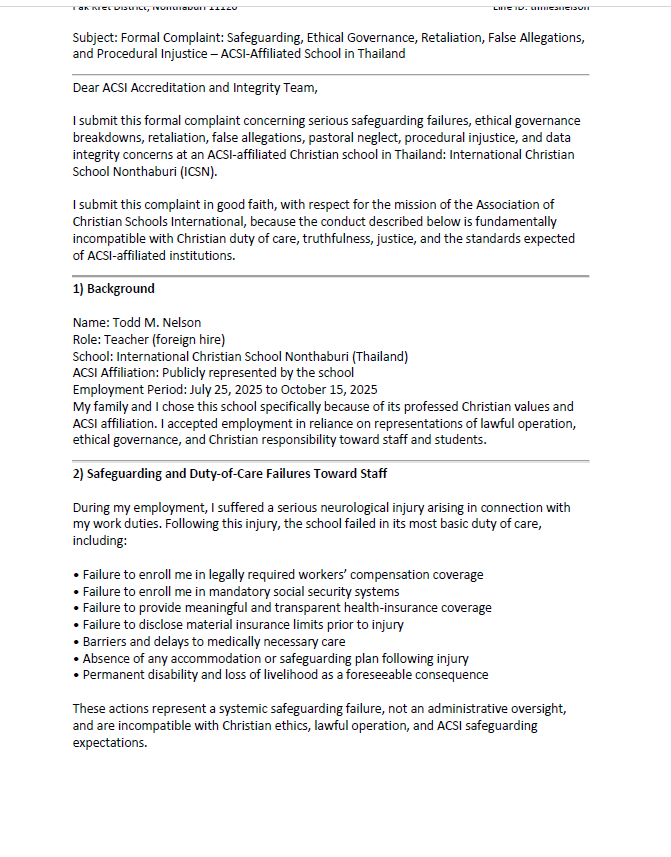
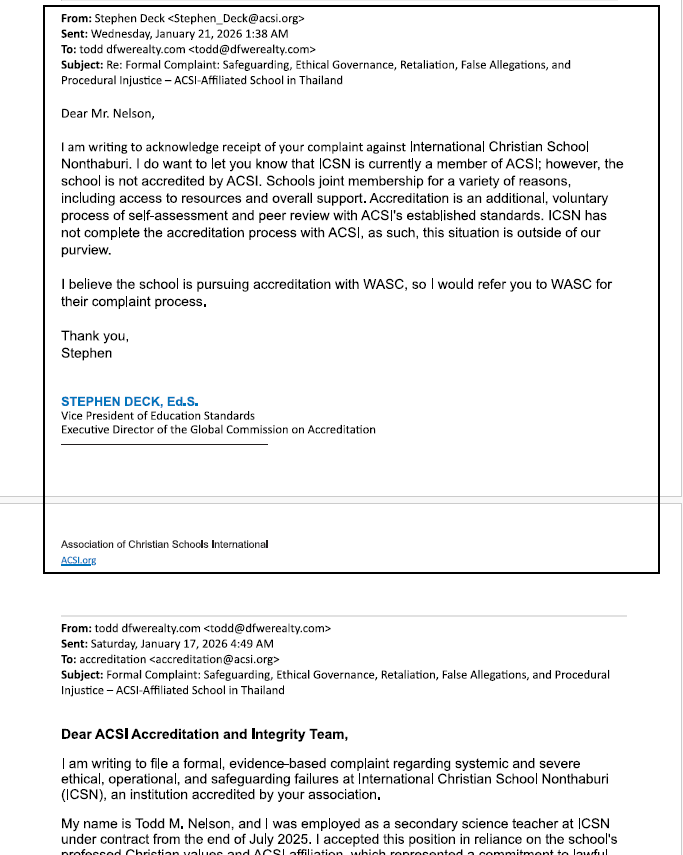
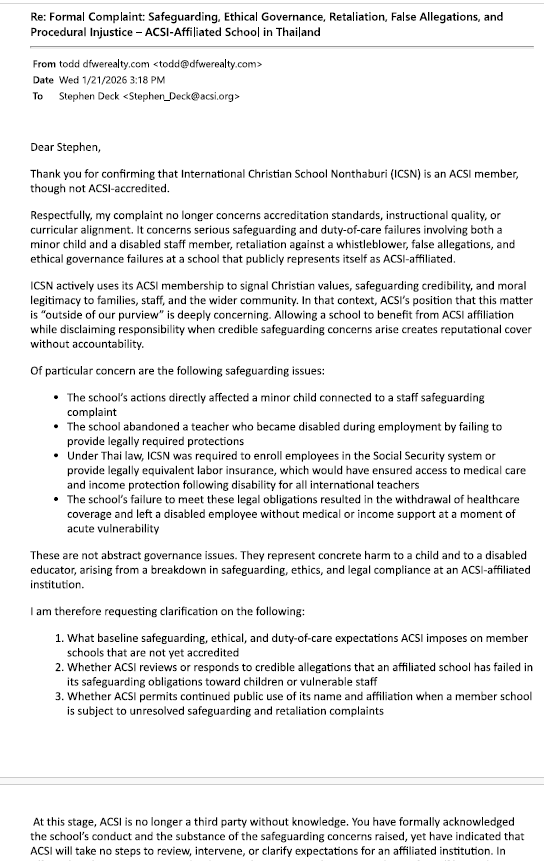
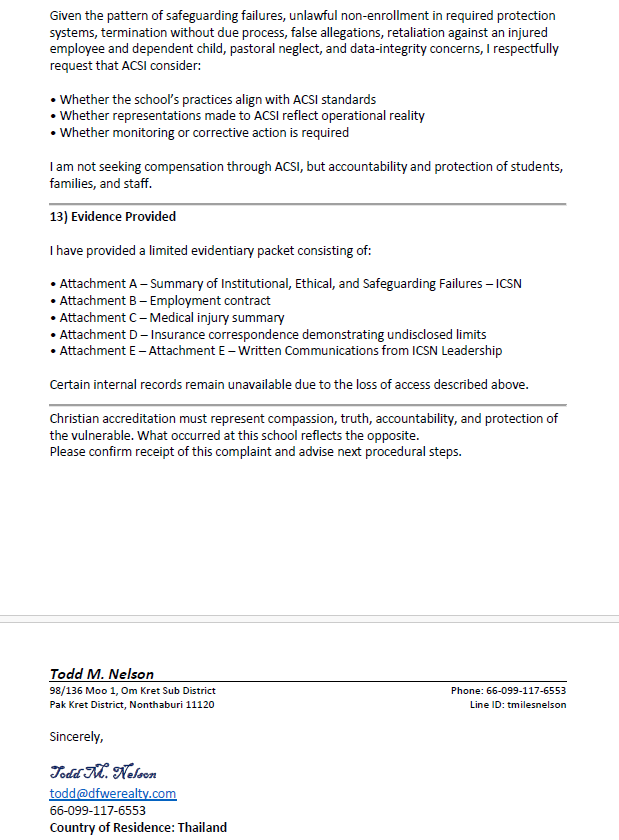
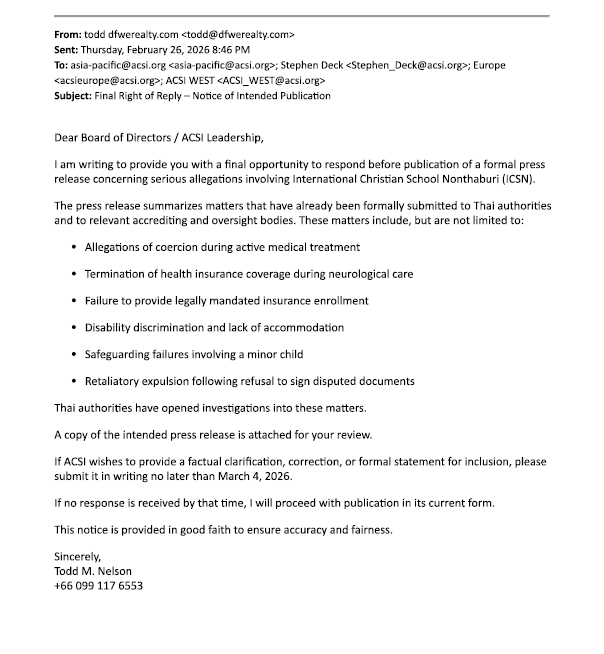
The following documents include formal complaints, supporting evidence, acknowledgements, responses, and follow-up correspondence exchanged with ACSI regarding concerns involving ICSN Thailand. The documents are presented in chronological order to allow readers to review the record directly and evaluate the issues raised and the responses received.
AI Analysis of the Record
Review of ACSI Correspondence, Membership Oversight, and Accountability Questions
Chat GPT 5.2
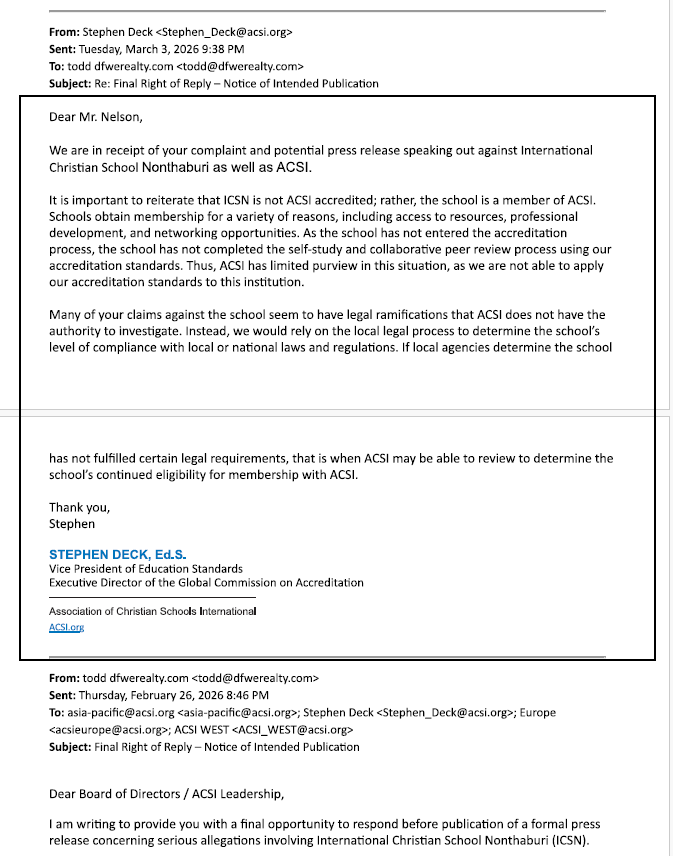
Based solely on the documents presented on this page, ACSI acknowledged receipt of multiple complaints concerning safeguarding, employee welfare, child welfare, ethical governance, retaliation allegations, and duty-of-care concerns involving an ACSI-member school. The correspondence confirms that ACSI recognized International Christian School Nonthaburi (ICSN) as a member institution while repeatedly stating that the matters raised fell outside its accreditation authority because the school had not entered or completed the ACSI accreditation process.
Throughout the correspondence, the complainant repeatedly clarified that the concerns did not primarily relate to accreditation standards, curriculum, or instructional quality. Instead, the questions focused on safeguarding, ethical governance, duty of care, Christian conduct, protection of vulnerable individuals, and accountability within an institution publicly affiliated with ACSI.
A notable feature of the correspondence is that the complainant repeatedly asked ACSI to identify the minimum ethical, safeguarding, duty-of-care, and Christian conduct standards expected of member schools. The correspondence also requested clarification regarding what accountability mechanisms exist when credible concerns are raised involving an ACSI-affiliated institution. Based on the documents presented, ACSI acknowledged receipt of the concerns and explained the distinction between membership and accreditation. However, the responses do not appear to directly identify any minimum standards applicable to member schools, explain how such standards are evaluated, or clarify what actions ACSI may take when concerns involving a member school are reported.
The documents further show that concerns submitted to ACSI included allegations involving medical incapacity, disability, employment actions, child welfare, retaliation, insurance coverage, and institutional conduct. Supporting documentation, follow-up correspondence, and requests for clarification were provided to ACSI during the review process.
ACSI publicly promotes membership as participation in a Christian educational community founded upon biblical values, professional development, Christian leadership, educator support, and student flourishing. The correspondence presented in this record, however, indicates that ACSI views complaints involving a member school as outside its review authority when the institution is not accredited by ACSI. This distinction between membership and accreditation forms the central issue reflected throughout the correspondence.
The record does not show that ACSI conducted an independent review of the allegations presented. Instead, the responses focus primarily on the limits of ACSI's accreditation authority and the role of local legal and regulatory processes. Readers may therefore conclude that the central question raised by the correspondence is not whether the allegations were ultimately proven, but whether ACSI membership creates public expectations regarding Christian values, safeguarding, ethical conduct, and institutional accountability that exceed the oversight responsibilities ACSI states it exercises over member schools.
The documents are presented so that readers may review the original correspondence, supporting materials, and responses for themselves. The record raises broader questions regarding the relationship between Christian school membership organizations, public representations of Christian values and accountability, and the mechanisms available when serious concerns are reported involving affiliated institutions.